First days and new beginnings
Choosing a first-day-of-school story for a small, real beginning
A quiet way to use a first-day-of-school story before a new classroom, new routine, or new goodbye—without making the book carry the whole moment.

A first day can be exciting, ordinary, wobbly, busy, or all of those at once. A story cannot tell a child how to feel, and it does not need to. It can simply make room for a familiar moment before something new begins: a child sees a character prepare, pause, ask a question, or take one small step. That can be enough to start a conversation without asking for a perfect answer. It can also give a grown-up a calmer way to be nearby, without turning the book into a lesson or a rehearsal for every possible school-day detail.
A gentle starting point
Read this the evening before, over breakfast, or whenever the new beginning is near. Choose one idea only. Your child can listen, point, change the subject, or ask to hear the same page again. The aim is connection, not rehearsal.
A first-day story is a place to land, not a plan to perform
Before a new school morning, adults often carry a full bag of hopes: that a child will walk in happily, find a friend, remember the routine, and come home with a good story. Children may carry a much smaller and more immediate set of thoughts: Where will my shoes go? Will someone know my name? Can I sit near the window? Both kinds of thoughts are allowed. A story can hold the moment between them without asking anyone to solve it.
Choose a book with a character who notices the beginning. The character does not need to become instantly confident, and the story does not need a shiny perfect ending. Often the most useful page is the one where the character pauses, looks around, holds something familiar, or makes one small choice. That is the page a child can return to when their own day feels big.
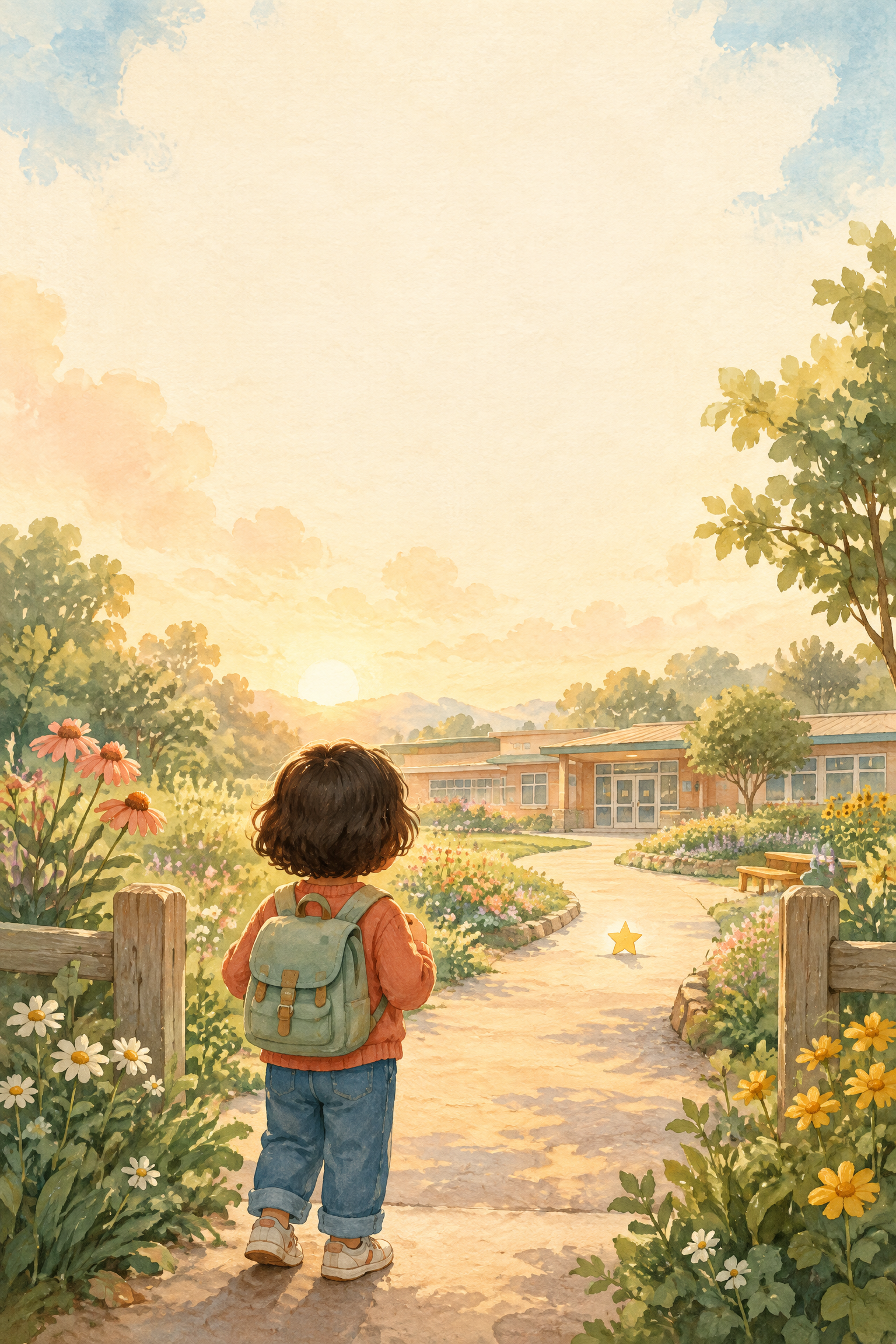
If your child does not want to talk about school, the story can still work. Read it because it is warm, interesting, or beautiful. A child might listen quietly, point to the backpack, ask about the flowers, or choose another book entirely. Shared reading does not need a visible result to be worthwhile.
Keep the preparation small enough to be real
A useful story ritual should fit inside the time and energy your family actually has. You do not need a long discussion, a themed worksheet, or a promise that tomorrow will feel easy. One page, one question, and one practical choice can be plenty. For some children, the best time is the evening before. For others, it is breakfast, the car ride, or the moment after they have already come home.
Try noticing what is already familiar. Perhaps the child has a bag they like, a grown-up who will walk with them, a favourite snack for after school, or a small goodbye routine. These ordinary anchors can feel more useful than a big speech about bravery. The goal is not to make the new place feel exactly like home. It is to carry a little steadiness into a new place.
If there is a practical question, answer it simply when you can. If you do not know yet, it is fine to say so. A child can hear: “I am not sure where the hooks are, but we can look together when we arrive.” Honest, contained answers are often more comforting than filling every quiet moment with reassurance.
Let the child own the pace of the conversation
Some children talk before a new beginning. Some talk after. Some show you through play, pictures, movement, or a request to read the same page three times. Leave space for all of those ways. Questions work best when they are invitations, not a check on whether the child is ready.
You can wonder aloud about a character rather than asking directly about the child. “I notice the child in this picture is holding their star tightly. I wonder what the star is helping them remember.” This gives a child an easy way to join in, disagree, or simply listen. It also keeps the story’s feelings safely on the page when that is what the child needs.
After the school day, resist the pressure to turn the car ride or doorway into an interview. Offer a gentle open door instead: “I’m here when you want to tell me about one part.” A snack, a bath, a favourite book, or a little ordinary silence may come before the words.
A ten-minute first-day ritual
Read, choose, carry
- 1Read one short section of a story where the character begins something new. Stop before the ending if that feels better.
- 2Invite your child to choose one familiar thing for tomorrow: a word, a snack, a small object where appropriate, or a plan for after school.
- 3Close with one sentence that does not demand a feeling: “We can take this one small step, then we can come back together.”
A story for the moment in front of you
First Day, One Small Step
Turn one small step into a story they can revisit.
First Day, One Small Step is a personalised digital story about a child following a paper star through a welcoming morning. It is made for a calm grown-up-and-child read together, before or after a new school day.
Personalised 5–8 minute digital story
Family Bookplate dedication
A grown-up reviews the private proof before the final digital story is delivered.
Four small ways to choose and share a first-day story
01
Look for a story with room for mixed feelings.
A first-day story can include curiosity and uncertainty in the same moment. A book does not need to promise that every child will feel brave or happy straight away.
02
Pause at the character’s first small action.
It might be putting on shoes, carrying a familiar object, waving at the door, asking one question, or standing near a grown-up. Notice the beginning rather than rushing to the ending.
03
Let the child choose one familiar part to carry forward.
A breakfast, a book in the bag, a kind goodbye, or a plan for after school can become a simple point of connection. Keep it practical and true to your family.
04
Close with a sentence that leaves room.
Try: “You can tell me about one part, lots of parts, or nothing yet.” A child does not owe anyone a report of their first day.
05
Save the story for another day too.
A familiar story can still be useful after the first morning. Returning to it later lets a child notice a different detail without turning the book into a test.
A little closing thought
A book can be a companion, not a promise.
The most helpful first-day story is often one that leaves space for the real child and the real day. Read slowly, keep the conversation optional, and let the small practical rituals around the story do their own quiet work. If your child is persistently distressed or the transition is affecting daily life, their school and a qualified child-development or health professional can help you decide what support fits.